
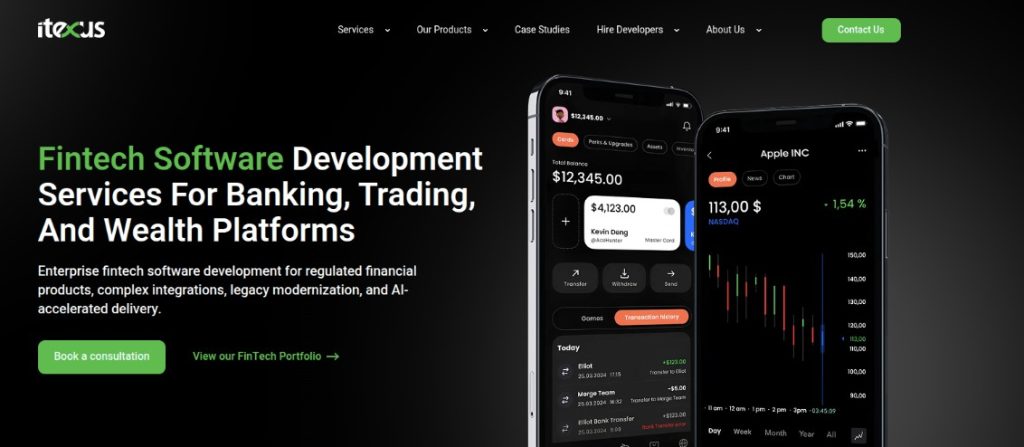
Managed cloud services help organizations operate, secure, and optimize infrastructure after it is deployed. Daily responsibilities now extend beyond server uptime to incident response, identity management, cost governance, and application performance. Hybrid and multicloud estates add another layer of complexity as businesses coordinate public platforms with existing systems. A reliable operating model connects technical support with clear responsibilities for backups, resilience, and change management.
1. Itexus
Itexus connects managed cloud operations with DevOps and custom software engineering. Its cloud infrastructure practice works with AWS, Microsoft Azure, Google Cloud, and IBM Cloud, covering infrastructure setup, cloud migration, platform audits, cost optimization, automated monitoring, and backup and recovery. Infrastructure-as-code tools such as Terraform, CloudFormation, and Ansible support repeatable deployments and configuration management.
The company also works with Docker and Kubernetes, CI/CD pipelines, performance monitoring, and DevSecOps practices. This combination is relevant to businesses running custom financial platforms and other application-intensive systems where cloud reliability depends on both infrastructure and software release processes. Organizations can bring infrastructure improvements, deployment automation, and application development into a coordinated technical engagement.
Key Facts
- Best for: Cloud infrastructure supporting custom business applications
- Core services: Managed cloud, cloud setup, migration, optimization, monitoring, backup and DevOps
- Cloud platforms: AWS, Azure, Google Cloud and IBM Cloud
- Technologies: Terraform, Ansible, Docker, Kubernetes and CI/CD
Contact Information
- Website: itexus.com
- Email: [email protected]
- LinkedIn: www.linkedin.com/company/itexus
- Facebook: www.facebook.com/itexus
- Twitter: x.com/ItexusSoft
- Instagram: www.instagram.com/itexus.soft
- Address: 8, The Green, STE road, Dover, DE 19901, United States
2. OSKI Solutions
OSKI Solutions combines cloud engineering with the ongoing operation of applications and infrastructure. Its cloud development and migration services cover AWS, Microsoft Azure, and Google Cloud, with attention to workload design, scaling, identity controls, and cost management. OSKI also addresses performance under production traffic through workload profiling, autoscaling policies, and infrastructure optimization.
Cloud work can be paired with backend engineering, system integration, software maintenance, and DevOps support. That joined-up approach is useful when problems cross the boundary between an application and the infrastructure beneath it. Rather than separating cloud setup from subsequent product changes, teams can coordinate deployment pipelines, application updates, cloud resources, and ongoing technical support.
Key Facts
- Best for: Businesses combining application engineering and cloud operations
- Core services: Cloud architecture, migration, optimization and DevOps
- Cloud platforms: AWS, Azure and Google Cloud
- Specialization: Infrastructure and application performance
Contact Information
- Website: oski.site
- Email: [email protected]
- LinkedIn: www.linkedin.com/company/oski-solutions
3. A-listware
A-listware delivers cloud management through its managed IT and infrastructure services. It handles cloud deployment, application migration, resource monitoring, ongoing administration, infrastructure assessments, and optimization. The provider works with AWS and Azure environments, as well as cloud and on-premises infrastructure that needs to be operated together.
Its offering also includes network operations, server administration, security assessment, managed DevOps, and application support. Businesses with limited internal infrastructure capacity can use the same provider for cloud operations and adjacent IT requirements. A-listware’s broader software-development expertise can be helpful when changes to cloud infrastructure must be coordinated with the applications and delivery pipelines it supports.
Key Facts
- Best for: Managed cloud combined with IT infrastructure support
- Core services: Cloud administration, deployment, migration and monitoring
- Cloud platforms: AWS, Azure and hybrid environments
- Additional capabilities: Managed DevOps, security assessment and application support
Contact Information
- Website: a-listware.com
- Email: [email protected]
- Facebook: www.facebook.com/alistware
- LinkedIn: www.linkedin.com/company/a-listware
- Address: St. Leonards-On-Sea, TN37 7TA, UK
- Phone: +44 (0)142 439 01 40

4. Net-devs
Net-devs approaches cloud management through senior-led cloud and platform engineering. Its Cloud & Platform practice includes cloud-native architecture, infrastructure as code, and platform work on Microsoft Azure, AWS, and Google Cloud. Terraform and Kubernetes are part of its published stack, connecting infrastructure automation with modern application delivery.
The firm also develops enterprise software across .NET, JVM, Node.js, Python, and Go. This makes its cloud work useful in projects where architecture, deployment automation, and the application codebase must evolve together. Teams developing complex internal platforms can involve Net-devs in infrastructure decisions, reusable delivery patterns, and the software services that ultimately run on the platform.
Key Facts
- Best for: Cloud-native architecture tied to enterprise software
- Core services: Cloud and platform engineering, infrastructure as code
- Cloud platforms: AWS, Azure and Google Cloud
- Technologies: Terraform, Kubernetes and enterprise application stacks
Contact Information
- Website: net-devs.com
- Email: [email protected]
- Phone: +48 571 282 759
- Address: Obrzeżna 1D, 02-691 Warsaw, Poland
- LinkedIn: www.linkedin.com/company/net-devs

5. SoftPro
SoftPro combines cloud infrastructure work with custom software development. Its cloud offering covers cloud-native application engineering, migration, and infrastructure management on AWS and Microsoft Azure. The company also works on lift-and-shift projects, containerization, and cloud-native re-architecture for legacy enterprise systems.
The connection with software development is central to its relevance for managed cloud projects. An organization migrating a .NET or web application can coordinate changes to code, deployment architecture, and the environment hosting the application. That approach is useful when cloud support forms part of a longer modernization program rather than a one-off hosting decision.
Key Facts
- Best for: Cloud infrastructure supporting custom applications
- Core services: Cloud-native development, migration and infrastructure management
- Cloud platforms: AWS and Microsoft Azure
- Technologies: .NET, containerization and modern web stacks
Contact Information
- Website: soft-pro.pl
- Address: Poland, Warsaw Mazowieckie Voivodeship, 13 Erasmus Ciołka St. 401

6. 21CENTURY.TECH
21CENTURY.TECH builds production software with senior engineers responsible for architecture, code review, QA, security decisions, and delivery. Its workflow includes CI/CD, testing, documentation, refactoring, and deployment to client infrastructure or environments operated by the studio. These capabilities connect deployment and operational considerations directly to the software-development process.
For teams managing cloud-hosted applications, the studio provides an engineering-focused route to improving release processes and keeping deployments aligned with application changes. Legacy refactoring and third-party integrations can be delivered alongside production deployment, making it relevant when the cloud environment is closely tied to the ongoing evolution of a custom product.
Key Facts
- Best for: Product teams needing infrastructure-aware software delivery
- Core services: Full-stack engineering, refactoring and integrations
- Operational capabilities: CI/CD, testing and production deployments
- Delivery model: Senior-led engineering with AI-assisted workflows
Contact Information
- Website: 21century.tech
- Email: [email protected]
Conclusion
Managed cloud services are increasingly defined by operational responsibility, not simply access to hosting resources. Organizations need clarity on who monitors infrastructure, resolves incidents, controls spending, manages backups, and approves changes to production systems. The requirements differ significantly between a small Azure-based workplace and a regulated enterprise spanning several cloud platforms. Strong contracts distinguish routine administration from architecture work, application support, and emergency response. Security, disaster recovery, and cost optimization also need measurable processes rather than broad service promises. As cloud environments grow more automated, keeping accountability clear remains essential to maintaining reliable operations.